AI development is moving fast, and alignment research is not moving fast enough to deal with superintelligent models. This is a problem. One of the most proposed solutions to this is to implement and AGI pause or slowdown - make it take longer to build AGI, so alignment research can catch up in the meantime. However, it’s unclear to me how proponents of an AGI pause want this to be implemented.
To be clear, I’m not arguing that passing an AGI pause is out of the realm of possibility. It seems to me that the major American labs - OpenAI, Anthropic, Google, Meta - are all law-following organizations, and thus American AGI regulation would work on them. Similarly, I think that a US-China AGI pause is also possible. I instead write this post to discuss what such legislation might entail.
To examine my concerns with current pause proposals, I’ll consider PauseAI’s proposal1 for an AI pause.
Implement a temporary pause on the training of the most powerful general AI systems, until we know how to build them safely and keep them under democratic control.
I have a few major concerns with this:
- How do you understand when AGI is safe to build?
- To what extent do you risk a safety overhang?
- How do you ensure and understand when alignment research has caught up?
In addition, I have a few other wants during an AI pause that I’ll discuss.
Resuming AGI Development
Despite having good intentions, many environmental justice groups have shaped the world for the worse. Nuclear power has had it’s reputation soiled by anti-nuclear groups, causing a shift from nuclear power to more traditional fossil fuels. This cost many lives. Similarly, the increase in regulations on construction and industry that was driven by the environmental movement has caused meaningful suffering in the US - yet, at the time they proposed their regulation, they were probably entirely justified in their actions.
AGI, as imagined, will be a transformative technology. It’s unclear to me how AGI will affect the world economically, but enabling humanity more capability for intellectual work will without a doubt lead to progress.
In Optimal Timing to Build Superintelligence, Nick Bostrom tries to understand when to build superintelligence, given some priors over the progress of safety research and risk, presenting the following graph. I recommend reading the paper, which examines “how to pause”, just like this post.
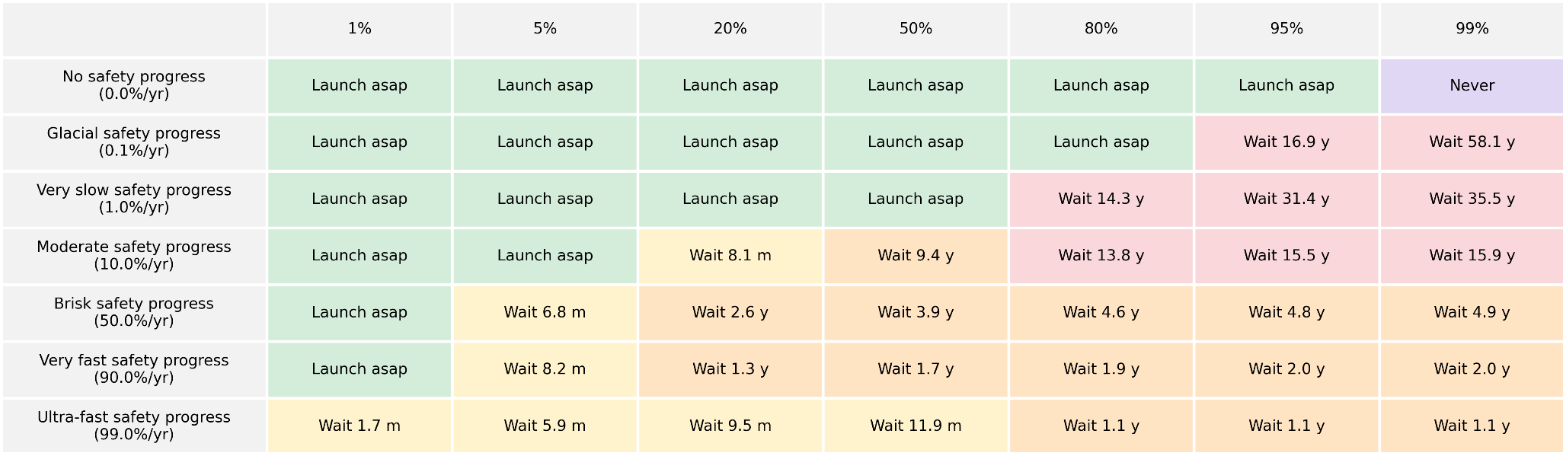
Even if I disagree with their specific numbers, I agree with their overall point - that intelligence is useful, and that we should build it when it’s safe enough to do so. One of my most significant worries with AGI pausing is that we extend the pause indefinitely and subsequently miss out on all the benefits that come with it.
Furthermore, there are actors that may not comply with an international pause, such as AGI projects from rogue states, terrorist groups, and other non-state actors; despite not being real contenders in the current AGI race, after algorithmic improvements and compute access being more widespread, it seems feasible that in a few decades anyone could build towards AGI.
To this extent, we should almost guarantee that AGI development continues, unless alignment is entirely unfeasible. This is a risk that we should be willing to take. We should thus work towards understanding when we feel comfortable resuming AGI development.
This is really difficult - you’re dealing with unknown unknowns here, since it’s unclear what the landscape of alignment is going to look like. With access to the most recent models (Claude Opus 4.7 and Codex 5.4) at time of writing, there are enough gaps in our understanding of current models that making progress towards alignment is meaningfully possible.
However, I think all of this leaves room for optimism! The first pause will be huge and monumental, and it will require building further infrastructure to support coordination. Consider the following model:
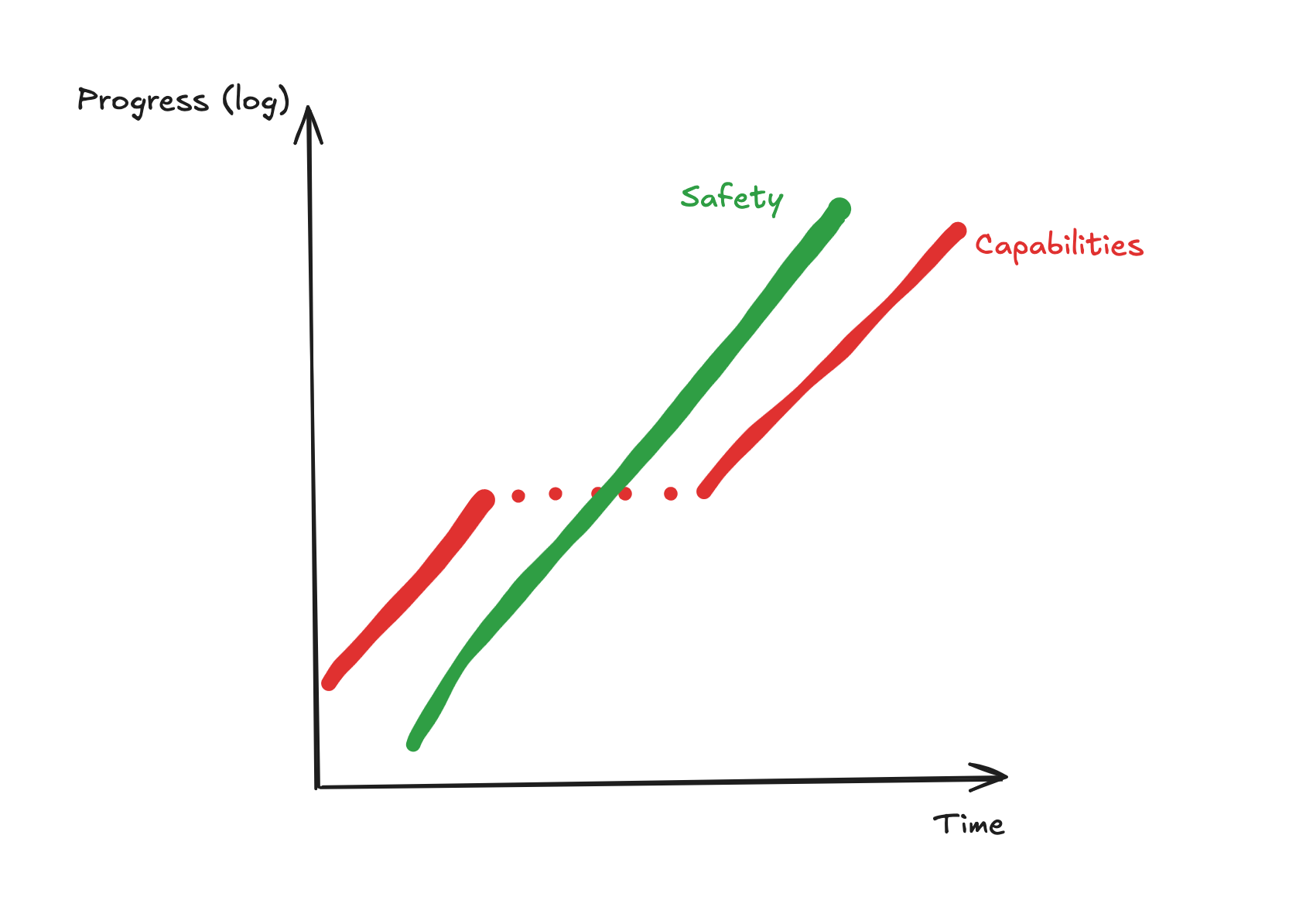
This models a true pause - there’s no capabilities overhang that causes the rate of capabilities progress to rapidly accelerate after the pause is lifted. We’re also assuming the acceleration of safety research due to automation of alignment.
Furthermore, it assumes that the rate of safety progress is comparable to the rate of capabilities progress. It’s unclear to me whether this is reasonable - it seems clearly false at the moment, but this might be just because the field is less mature than ML as a whole - in a few years, the duration of a pause, will the rate of safety research catch up to capabilities progress? I’ll touch on this later.
As it stands, in the case of any pause, we would want for the safety research to have progress as much as capabilities research post-pause, and also we would want for the rate of progress of safety research (loosely the exponent on the exponential) to be comparable to the rate of progress of capabilities research. To ensure that we can resume AGI development, we counterintuitively want to be more rigorous about pausing - setup infrastructure to measure the rate of safety progress, and also set up infrastructure to ensure that, if we resume AGI development too early, we have the optionality to pause again. If we make it so that we can pause again, we can unpause easier and bring about abundance faster.
Safety Overhangs
Even in a pause, labs should have access to huge amounts of compute. Claude Code and Codex and other products in their class have been hugely beneficial for the world, and the world hasn’t adapted to them as they’ve come. Even if models don’t get any better, there are still many areas that are underexplored, and these models haven’t diffused across society sufficiently. Thus, we’d want to ensure that labs have the ability to continue serving their models. A nice to want, but by no means a need, is to ensure that labs also have the ability to continue finetuning models at a small scale.
Given huge amounts of compute - and compute deployments that will continue - labs after the pause will have the ability to quickly scale up their training runs. If current progress can be accelerated by compute, then we should expect progress to still hold during the pause.
EpochAI estimates that compute grows at around $3 \times$ per year, and algorithmic improvements grow at around the same pace. This means that the current rate of progress approximates a $9 \times$ growth rate in resources, year over year. If we subscribe to a compute theory of progress, then this pause still allows for $3 \times$ YoY growth accounting to compute scaling; probably slightly less due to the economic effects of the slowdown. If we slow down compute growth to $2 \times$ YoY, then we still only slow overall progress by three times.
I think this leaves a concerning safety overhang - revising the previous model, we should expect something more like the following.
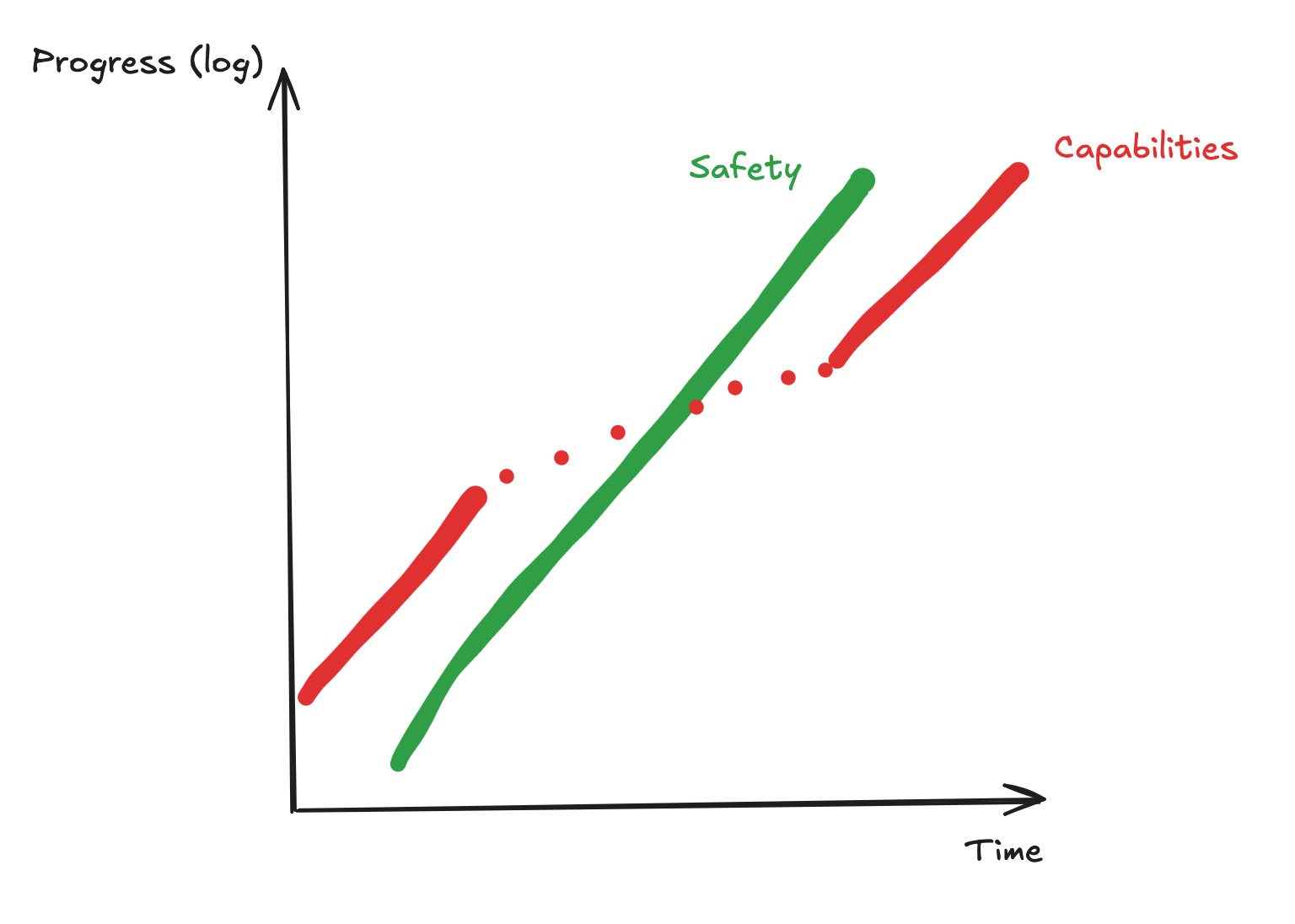
We have to make some forecast of what capabilities progress looks like during the pause, and determine how and when to unpause based on measurements of safety progress and forecasts of capabilities progress.
It’s not entirely clear to me how much algorithmic / non-compute progress we can expect if compute isn’t as abundant as it is right now; quite clearly having lots of training compute will lead to faster progress and a tighter iteration cycle, but I’m not sure how progress looks like without training compute, and I think my projection of $2 \times$ YoY progress is conservative.
In any case, I feel fairly confident saying that we get safety overhang, and we should expect, from a short pause (under a decade for example) for AGI progress to happen at around $1/2 - 1/5$ of the the current rate.
Side note: DeepSeek released DeepSeek V4 today, trained on ~1-2 OOM less compute than the current frontier models, and remains somewhat competitive with the frontier. This leads me think that we might be able to have lots of progress without compute scaling, and puts my probability mass closer to the $1/2$ than the $1/5$. Western labs may be using more compute because they have access, but the compute-sparse domain may also be fruitful
Measuring Safety Progress
This feels like the crux of the problem. How do you measure safety progress?
There are two takes here: you can wait until you one-shot alignment and train a safe frontier model from the ground up with some security, or you slowly scale training up while checking in on your safety metrics, pausing if you see misalignment.
I think the former is kind of fake - it doesn’t seem like theoretical alignment agendas are moving fast enough to do this sort of “full alignment” so we can verify the whole system before training. Instead, I think that the latter is much more feasible.
It’s still unclear exactly how you do this, especially since models are more and more eval-aware, and it’s possible that they seem aligned in evals but not in deployment, but this seems like a solvable problem over the next few years. You can look at model internals and probe for awareness, and conquer alignment through a thousand cuts.
However, I think this broadly looks like training a model to the same capability as the frontier models pre-pause with modern alignment techniques
A Proposal
I don’t want this piece to be one where I dunk on possible pauses and instead put my money where my mouth is. In order for a pause to go successfully, I think I’d like to see a few things happen.
- Forecasting Safety Progress: We want to be able to predict a) the rate of progress of safety research b) how it compares to capabilities progress and c) scaling laws for safety progress, like we do with compute-capabilities scaling laws.
- Guaranteed, slow resumes: To prevent the indefinite pause of AGI development, we should bake in a date to resume AGI development, and a plan to have this resume be slow
- Resumeable Pauses: We should give ourselves freedom to make a mistake and resume a pause; it’s important to do so in a way that isn’t abusable, but it probably reduces the risk of unpausing too early since you can pause again, and thus you increase the likelyhood of unpausing in general
- Accelerating Safety Research: The pause only works if safety research outpaces a potential overhang, and if forecasting finds safety progressing too slowly, we should find ways to accelerate safety research.
The actual pause, then, would look like the following:
- Labs Keep Inference Compute: Models are good for the world - labs should serve them
- Labs Are Allowed Some Finetuning: Labs should be allowed to finetune models and instead are limited to some number of training runs per time interval, at some compute intensity
- Labs Should Dedicate Much of Current Training Compute to Safety: Enforcing this is probably difficult, but OpenAI’s past superalignment efforts are a good inspiration, dedicating 20% of organization compute to safety research with the rest used on inference
Their entire proposal can be found here, but I don’t think the rest of the proposal addresses the concerns that I pose. I am not trying to strawman their proposal, and if you think that I am please do let me know.